
Models
(What to Build)
Models are where psychology and design meet. They are made by researchers who study how learners learn best, and they are used to guide the design and development of learning products.
You'll need to be familiar with them to know what you should build and why. You don't need to be an academic during your interview, but you should be able to speak briefly about them, and any experience you have using them to build projects.
Bloom's Taxonomy
Bloom's taxonomy is used to write objectives (what you want your learner to be able to do at the end of the lesson). There are terminal objectives, which are end-goals of a course or major section, and enabling objectives, which are bite-sized goals for each subsection or microlearning.
Bloom's taxonomy shows how the learner absorbs information:
-
First, they can recall the information at will.
-
Then they begin to understand the information.
-
Then they are able to apply the information to their work.
-
Then they can take the information apart and think about how it works.
-
Then they can have clear judgement on the information.
-
Finally, they will have the ability to use the information to create something new.
Speaking of objectives, be sure to make them SMART:
Specific - not vague
Measurable - so you know when the learners meet them
Achievable - reasonable to accomplish
Relevant - goals that matter to the learner
Time-bound - so they don't take forever to accomplish


ADDIE and SAM
These count as both models and frameworks.
Click here to go to the Frameworks page for more details about these.
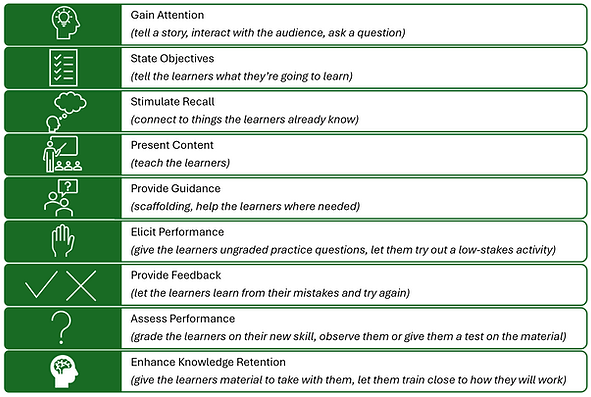
Gagne's 9 Events of Instruction
It's pronounced "gone-yay". Please don't pronounce it as gag-knee during your interview.
When you teach a class, here's a good outline for how it should go:
-
Gain Attention (tell a story, interact with the audience, ask a question).
-
State Objectives (tell the learners what they’re going to learn).
-
Stimulate Recall (connect to things the learners already know).
-
Present Content (teach the learners).
-
Provide Guidance (scaffolding, help the learners where needed).
-
Elicit Performance (give the learners ungraded practice questions, let them try out a low-stakes activity).
-
Provide Feedback (let the learners learn from their mistakes and try again).
-
Assess Performance (grade the learners on their new skill, observe them or give them a test on the material).
-
Enhance Knowledge Retention (give the learners material to take with them, let them train close to how they will work).
Kirkpatrick's Levels of Evaluation
The Kirkpatrick model of learning evaluation helps measure how well training went.
There are 4 levels, moving outward from measuring the effect of the training on the learner to the larger organization/company.
Level 1 - Reaction: the learner's personal evaluation of the training. (Do they think it was helpful?) You might hear about learners filling out "smile sheets", that's this level.
Level 2 - Learning: determines how well the learner retained the knowledge. This is often done with an assessment.
Level 3 - Behavior: shows if the learner is using their new knowledge on the job. This can be done through observation or manager feedback.
Level 4 - Results: measures the effect the training had on the business (money saved, less wasted product, fewer customer returns, etc.)

ARCS Model of Motivation
These are the things that get learners to want to learn the material.
They are often communicated in a WIIFM (pronounced whiff-um) statement: "What's in it for me?"
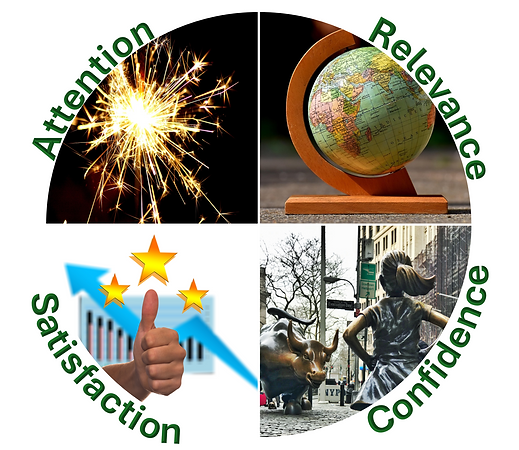
Learners care when you get and hold their attention, when the material is relevant to them, when they are confident they can perform the task by the end of the lesson, and when they are satisfied that they learned the material and understand it.
A hint about motivation: there are two types - intrinsic (an internal feeling of wanting to learn the material) and extrinsic motivation (someone telling them they have to learn). Adult learning focuses on intrinsic motivation because it works better than extrinsic.

Dick and Carey
(Also called the Systems Approach Model)
Walter Dick and Lou Carey wrote a book called The Systematic Design of Instruction, and in it, they wrote about a new way of looking at the design process. They use a systems view, where the different parts of the design process work together, instead of one happening after another.
These are the parts of this model, but the important thing is, they don't stay in this order, they loop back and repeat different parts depending on what the design needs in order to improve:
-
Identify instructional goal(s)
-
Conduct instructional analysis
-
Analyze learners and contexts
-
Write performance objectives
-
Develop assessment instruments
-
Develop instructional strategy
-
Develop and select instructional materials
-
Design and conduct formative evaluation of instruction
-
Revise instruction
-
Design and conduct summative evaluation
Smith and Ragan
Patricia Smith and Tillman Ragan came up with a model for instructional design that has three categories: analysis, strategy development, and evaluation.
This model focuses on the system at large, and can be used in any order as many times as needed.
